

ZDIN-Zahlen im Detail
Das umfangreiche ZDIN-Netzwerk aus Wissenschaft und Wirtschaft spannt sich über ganz Niedersachsen. Gemeinsam verzeichnen die Zukunftslabore und die Koordinierungsstelle beeindruckende Projekterfolge, die auf dieser Seite im Detail vorgestellt werden.
Wissenschaftliche Veröffentlichungen
To develop a decision support system for pediatric cardiology case conferences, the anonymization of 4,000 freetext medical case reports is required. This paper presents an anonymization strategy usin ...
To develop a decision support system for pediatric cardiology case conferences, the anonymization of 4,000 freetext medical case reports is required. This paper presents an anonymization strategy using LLM-AIx, a tool for structured information extraction based on large language models (LLM). The three-step process involves automatic extraction of personally identifiable information (PII) from the reports, evaluation of the results against a manually annotated ground truth, and replacement of identified PII with surrogate values, including controlled date shifting. Initial tests with six example reports revealed challenges regarding handling multiple attribute occurrences and consistent replacements. Future work will focus on full pipeline implementation and mapping clinical information to standardized terminologies such as SNOMED CT.
Autor*innen
- Darian Liehr (Hochschule Hannover)
- Dr. med. Theodor Uden
- Prof. Dr. Christian Wartena
- Prof. Dr. Volker Ahlers
- Prof. Dr.-Ing. Steffen Oeltze-Jafra (Technische Universität Braunschweig, Peter L. Reichertz Institut für Medizinische Informatik)
- Prof. Dr. med. Dr.-Ing. Michael Marschollek (Leibniz Universität Hannover, Forschungszentrum L3S)
- Prof. Dr. med. Philipp Beerabaum
- Prof. Dr.-Ing. Oliver J. Bott (Hochschule Hannover, Abteilung Information und Kommunikation)
Veröffentlichung
- Im Rahmen des Buches/Journals bzw. Konferenz: KI-Forum 2025 : KI in Forschung und Lehre an Hochschulen 2025
- Datum: 01.12.2025
Die Nutzung elektronischer Patientenakten (ePA) zur Datenspende bietet großes Potenzial für die medizinische Forschung, stellt jedoch hohe Anforderungen an Information, Kommunikation und Akzeptanz in ...
Die Nutzung elektronischer Patientenakten (ePA) zur Datenspende bietet großes Potenzial für die medizinische Forschung, stellt jedoch hohe Anforderungen an Information, Kommunikation und Akzeptanz in der Bevölkerung. Im Rahmen eines interdisziplinären Workshops anlässlich der 69. Jahrestagung der Deutschen Gesellschaft für Medizinische Informatik, Biometrie und Epidemiologie e.V. diskutierten in Dresden Expert:innen aus Medizinischer Informatik, Wissenschaftskommunikation und Patientenvertretung gemeinsam mit dem Publikum zentrale Fragestellungen zur Kommunikation der Datenspende an Bürger:innen.
Ziel war es, Bedingungen zu identifizieren, unter denen eine informierte und selbstbestimmte Entscheidung über die freiwillige Nutzung von Gesundheitsdaten für Forschungszwecke möglich ist. Im Fokus standen dabei die Fragen, wer über die Datenspende informiert, wie Vertrauen in Institutionen gestärkt, Nutzen und Risiken verständlich vermittelt und Zielgruppen angemessen erreicht werden können. Impulsvorträge und Diskussionen zeigten, dass es einer Vielzahl niedrigschwelliger, transparenter und zielgruppengerechter Informationsangebote durch glaubwürdige Akteure bedarf. Dabei gilt es, digitale Gesundheitskompetenz zu fördern, Zugangshürden abzubauen und Bürger:innen nicht nur technisch, sondern auch kommunikativ zu befähigen.
Der Beitrag verdeutlicht, dass eine wirksame Kommunikation zur Datenspende eine zentrale Voraussetzung für gesellschaftliche Akzeptanz und eine gerechte Teilhabe an digitaler Gesundheitsforschung darstellt.
Autor*innen
- Prof. Dr.-Ing. Oliver J. Bott (Hochschule Hannover, Abteilung Information und Kommunikation)
- Dr. Nicole Egbert (Netzwerk Versorgungskontinuität in der Region Osnabrück e.V.)
- Saskia Kröner
- Stefan Rühlicke (Georg-August-Universität Göttingen, Universitätsmedizin Göttingen, Institut für Medizinische Informatik)
- Björn Schreiweis
- Brigitte Strahwald (Ludwig-Maximilian Universität)
- Veronika Strotbaum
- Martin Wiesner
Veröffentlichung
- Im Rahmen des Buches/Journals bzw. Konferenz: GMS Med Inform Biom Epidemiol
- Datum: 28.11.2025
The 24th Special Topic Conference (STC 2025) of the European Federation for Medical Informatics (EFMI) was held in Osnabrück, Germany from 20–22 October 2025. The Conference was co-hosted by Osnabrück ...
The 24th Special Topic Conference (STC 2025) of the European Federation for Medical Informatics (EFMI) was held in Osnabrück, Germany from 20–22 October 2025. The Conference was co-hosted by Osnabrück University of Applied Sciences, the German Society of Medical Informatics, Biometry and Epidemiology (GMDS) and EFMI.
The theme of STC 2025 was “Good Evaluation – Better Digital Health”. In an era of rapid digital transformation, the conference highlighted that rigorous evaluation is essential to ensure the safety, effectiveness and sustainability of health IT innovations. While evaluation is often carried out at the very end of the development process, good evaluation starts at the outset of a project with an investigation of the context within which the implementation will take place and its determinants. In the best case, the evaluation will follow a longitudinal approach to capture the full impact of the implementation regardless of whether it is positive or negative. With the advent of powerful digital systems, including those making use of AI technology, evaluation is needed more than ever to prevent harm and ensure effectiveness and meaningfulness on a micro, meso and macro level. As digital interventions have multiple determinants and implications, evaluation methods have to consider the full spectrum of dimensions, ranging from technical and organisational aspects to human, social, ethical and
educational perspectives.
These proceedings present current scientific trends in the evaluation of digital health and AI-enabled systems in patient care. Some contributions address methodological topics such as evaluation paradigms and techniques, research models and frameworks that constitute the foundation of reliable and valid results. Others point to critical areas of investigation such as technical quality, including interoperability, as well as data protection and security. Non-technical areas of paramount importance, first and foremost ethics, are equally addressed. Many papers take the perspective of human and organisational factors combined with social and political aspects in their dual role as potential determinants and outcomes. Finally, educational aspects are covered by a number of papers addressing competencies and tools for enhancing education in the era of AI.
While these topics have been scientifically investigated by biomedical and health informatics for many decades, the latest AI developments impose a new imperative on the evaluation of digital health. These proceedings reflect the current debates and developments from a scientific point of view with the goal of having an impact on practice.
The proceedings are published by IOS Press in the series Studies in Health Technology and Informatics. Volumes in this series are submitted (for evaluation) for indexing by MEDLINE/PubMed; Web of Science: Conference Proceedings Citation Index – Science (CPCI-S) and Book Citation Index – Science (BKCI-S); Google Scholar; Scopus; and EMCare.
Autor*innen
- Prof. Dr. rer. nat. Ursula Hertha Hübner (Hochschule Osnabrück, Forschungsgruppe Informatik im Gesundheitswesen)
- Prof. Dr. Jan-David Liebe (Medizinische Hochschule Hannover)
- Arriel Benis
- Dr. Nicole Egbert (Netzwerk Versorgungskontinuität in der Region Osnabrück e.V.)
- Thomas Engelsma
- Parisis Gallos
- Daniel Flemming
- Valentina Lichtner
- Romaric Marcilly
- Oscar Tamburis
- Sidsel Villumsen
Veröffentlichung
- Im Rahmen des Buches/Journals bzw. Konferenz: Proceedings of the EFMI STC 2025 Conference.
- Datum: 20.10.2025 - 22.10.2025
Study objectives: Chronic wounds represent a significant economic and personal burden. For their successful treatment, the causes must be known and treated. Wounds caused by pyoderma gangrenosum (PG), ...
Study objectives: Chronic wounds represent a significant economic and personal burden. For their successful treatment, the causes must be known and treated. Wounds caused by pyoderma gangrenosum (PG), a rare inflammatory skin disease, are often misdiagnosed. This study, therefore, aims to develop a machine learning model capable of differentiating PG from other wound types, focusing on chronic leg wounds to address this diagnostic challenge.
Methods: We used 3674 wound photographs from three specialised wound centres with the four most common types of foot and leg ulcers and the rare inflammatory differential diagnosis PG. The convolutional neural network classifier ConvNeXt 'B' was pretrained on LAION2B, ImageNet12k and ImageNet 1k before being trained and fine-tuned on an 85:15 train, validation split.
Results: The model achieved an overall high accuracy in multiclass classification of the chronic wounds (unbalanced accuracy 90%, balanced accuracy 87%). The sensitivity for identifying PG was 94%, while the sensitivity forother chronic wound types was 97% for diabetic foot ulcers (DFU), 92% for venous leg ulcers (VLU), 78% for mixed leg ulcers and 74% for arterial leg ulcers.
Discussion: The machine learning model effectively differentiates PG from the most common leg and foot ulcers and was very accurate for classifying DFU and VLU. A higher rate of misclassifications occurred for the other vascular ulcers, that is, mixed and arterial leg ulcers. This aligns with the challenges in clinical practice.
Conclusion: Despite the limited number of wound images, this novel multiclass wound classification model accurately identified PG and differentiated leg and foot ulcer subtypes, providing a foundation for a diagnostic support system.
Autor*innen
- Dorothee Busch
- Mats Richter
- Jens Hüsers (Hochschule Osnabrück)
- Mareike Przysucha (Hochschule Osnabrück)
- Florian Kücking
- Jonathan Mang
- Maurice Moelleken
- Joachim Dissemond
- Jan Heggemann (Niels-Stensen-Kliniken Christliches Klinikum Melle GmbH Engelgarten 3)
- Dr. med. Guido Hafer (Niels-Stensen-Kliniken Christliches Klinikum Melle GmbH Engelgarten 3)
- Carola Berking
- Cornelia Erfurt-Berge
Veröffentlichung
- Im Rahmen des Buches/Journals bzw. Konferenz: BMJ Health & Care Informatics
- Datum: 01.10.2025 - 01.10.2025
This special issue of MIBE comprises contributions submitted to the Special Topic Conference “Good Evaluation – Better Digital Health” of the European Federation of Medical Informatics (EFMI). EFMI Sp ...
This special issue of MIBE comprises contributions submitted to the Special Topic Conference “Good Evaluation – Better Digital Health” of the European Federation of Medical Informatics (EFMI). EFMI Special Topic Conferences (STC) are scientific events focussing on a dedicated topic in biomedical and health informatics and are addressing particularly young and early career scientists. This year, the STC is hosted by the German Association of Medical Informatics, Biometry and Epidemiology (GMDS) and organised by Osnabrück University of Applied Sciences. Publishing contributions to a European conference illustrates MIBE’s general offer to colleagues from Europe and beyond to publish their work in this journal. As a first step, posters submitted as a three-page poster contribution to the STC were considered for publication and underwent the same rigorous peer review process as all contributions to the conference before they were proposed for publication in MIBE. Here they were peer reviewed again.
Nine out of 20 poster contributions submitted were accepted and published in this special issue covering topics of the theme “Good Evaluation – Better Digital Health”. Evaluation is a centre piece of the software and systems life cycle and starts – in contrast to usual anticipations – not at the end when the system has been rolled out but at the very beginning of the development process. It thus allows the integration of empirical patterns against which the testing can be performed such as user expectations and requirements. The articles “Co-creating a cancer screening dashboard with screening invitees and experts“ by Oldhoff-Nuijsink et al. [1] and “Building a digital platform for collaborative second opinions in rare disease: Integrating AI and healthcare networks for improved care“ by Lima et al. [2] illustrate the meaningfulness of early evaluations. Conversely and even a step earlier, evaluations of patients’ behaviour can stimulate the needs to foster long-term medication adherence through digital methods as was shown by Kim et al. in their study “Adherence to hormonal therapy in breast cancer patients: EHR-based retrospective data analysis” [3].
Evaluations and tests that are derived from frameworks, theories and concepts have a different background, however, need not contradict more empirically grounded evaluation targets. It is therefore useful to identify new frameworks as in the case of Hülsmann et al. in “Identifying assessment frameworks for digital public health interventions: First results of a scoping review“ [4] or to augment existing ones as was proposed by Grashof et al. in “A new perspective on eHealth acceptance: Combining health-related factors with the Technology Acceptance Model“ [5].
The emergence of more and more AI models for use in healthcare increases the necessity to conduct proper evaluation studies before such models can be integrated into systems for clinical use. The study by Galland-Decker et al. “Performance evaluation of Meditron3-70B in medical coding: Current limitations and integration perspectives for clinical practice” [6] investigated the performance of a medical large language model to generate SNOMED and ICD codes from vignettes and hinted at current flaws.
Evaluating a system often means evaluating the context in which the system is embedded in. This also applies to AI systems and their rootedness in models that have been developed on a specific set of data to be applied to fresh clinical data. The study by Slob et al. “FAIVOR – a push-button system for AI validation within the hospital“ [7] describes a tool that serves as an AI model repository and allows the evaluation of a given model on local data.
Evaluating applications and systems is often accompanied by educational measures to really obtain better digital health which means nothing less than better use from better digital systems. Two articles address education and training: “Developing competencies in health informatics: Blended teaching method “by Mannevaara et al. [8] and “AI and AR for inclusive health education“ by Focsa [9].
The studies presented in this special issue give rise to longitudinal measures to evaluate the output, outcome and impact of digital systems to finally appraise whether an application really contributed to better digital health.
Autor*innen
- Prof. Dr. rer. nat. Ursula Hertha Hübner (Hochschule Osnabrück, Forschungsgruppe Informatik im Gesundheitswesen)
Veröffentlichung
- Im Rahmen des Buches/Journals bzw. Konferenz: GMS Med Inform Biom Epidemiol
- Datum: 01.10.2025 - 01.10.2025
Wissenschaftliche Vorträge
Referent*innen
- Dr. Laura Mae Jacqueline Herzog (Universität Osnabrück, Institut für Geographie)
Vortrag
- Im Rahmen der Veranstaltung: Wasserbauseminar, TU Braunschweig
- Datum: 17.12.2025
Referent*innen
- M. Sc. Moritz Proff (Technische Universität Braunschweig, Institut für Automobilwirtschaft und Industrielle Produktion)
Vortrag
- Im Rahmen der Veranstaltung: 14th International Symposium on Environmentally Conscious Design and Inverse Manufacturing (EcoDesign2025)
- Datum: 13.11.2025
Referent*innen
- Prof. Dr. Thomas S. Spengler (Technische Universität Braunschweig, Institut für Automobilwirtschaft und Industrielle Produktion)
Vortrag
- Im Rahmen der Veranstaltung: 14th International Symposium on Environmentally Conscious Design and Inverse Manufacturing (EcoDesign2025)
- Datum: 13.11.2025
Referent*innen
- Dr. Kerstin Schmidt (Technische Universität Braunschweig, Institut für Automobilwirtschaft und Industrielle Produktion)
Vortrag
- Im Rahmen der Veranstaltung: 14th International Symposium on Environmentally Conscious Design and Inverse Manufacturing (EcoDesign2025)
- Datum: 13.11.2025
Referent*innen
- M. Sc. Marvin Chyke Hempel (Leuphana Universität Lüneburg, Institut für Produktionstechnik und -systeme)
- Prof. Dr.-Ing. Jens Heger (Leuphana Universität Lüneburg)
Vortrag
- Im Rahmen der Veranstaltung: "Schöpfwerk - Siele - Wasserhaltung" im Wassernetzwerk Nordost-Niedersachsen; Veranstalter: Amt für regionale Landentwicklung Lüneburg; Bericht: https://www.arl-lg.niedersachsen.de/startseite/aktuelles/informationen_und_hinweise/technische-innovationen-fur-eine-klimaresiliente-wasserwirtschaft-in-nordost-niedersachsen-246647.html & https://www.leuphana.de/institute/ipts/aktuell/ansicht/2025/11/07/forschung-fuer-einen-nachhaltige-wasserwirtschaft-an-der-norddeutschen-kueste.html
- Datum: 07.11.2025
Außerwissenschaftliche Beiträge
Referent*innen
- Stefan Wittek (Technische Universität Clausthal)
Beitrag
- Anlass: 2nd Regionales Wasser Forum, Braunschweig (https://www.regionalverband-braunschweig.de/news/wasserextreme-2-regionales-wasserforum-der-region-schaut-auf-hochwasser-und-starkregen)
- Datum: 12.12.2025 - 12.12.2025
Referent*innen
- Prof. Dr.-Ing. habil. Monika Sester (Leibniz Universität Hannover)
- M. Sc. Tim Schimansky (Leibniz Universität Hannover, Institut für Kartographie und Geoinformatik)
Beitrag
- Anlass: Unimagazin - Leibnizuniversität Hannover (https://bc.pressmatrix.com/de/profiles/f5ab697fcf1d-leibniz-universitat/editions/unimagazin-3-4-2025/pages/page/4)
- Datum: 10.12.2025 - 10.12.2025
Referent*innen
- Prof. Dr. rer. nat. Ursula Hertha Hübner (Hochschule Osnabrück, Forschungsgruppe Informatik im Gesundheitswesen)
Beitrag
- Anlass: Kolumne. f&w.
- Datum: 01.11.2025
Referent*innen
- Arne Reinecke (Leibniz Universität Hannover)
- M. Sc. Adina Brandt (Leibniz Universität Hannover, Institut für Hydrologie und Wasserwirtschaft)
- M. Sc. Tim Schimansky (Leibniz Universität Hannover, Institut für Kartographie und Geoinformatik)
Beitrag
- Anlass: Technik Salon
- Datum: 30.10.2025 - 30.10.2025
Referent*innen
- Prof. Dr. rer. nat. Ursula Hertha Hübner (Hochschule Osnabrück, Forschungsgruppe Informatik im Gesundheitswesen)
Beitrag
- Anlass: Wissen Hoch N. 2025. https://doi.org/10.60479/5XNV-H942
- Datum: 02.10.2025
Messebeiträge
Vom 09.11.25 bis zum 15.11.25 fand in Hannover die Agritechnica statt, die Weltleitmasse für Landtechnik. Mit über 2.849 Ausstellern aus 52 Ländern und insgesamt rund 476.000 Besucherinnen aus 171 Ländern ist sie eine der größten europäischen Messen in Hinblick auf neueste Technologien aus und für die Landwirtschaft. Die Zukunftslabore Agrar und Wasser nahmen an der Veranstaltung teil und konnten am Gemeinschaftsstand des assoziierten Partners Agrotech Valley Forum e. V. ihre aktuelle Forschung, sowie auch das neue Transferprojekt "AdAgriSpray" vorstellen.
Im Rahmen der Messe sind viele Gespräche bezüglich der aktuellen Forschungsarbeit der Zukunftslabore getätigt worden. Es konnte sich mit zahlreichen fachkundigen Besuchern ausgetauscht werden, auch sind einige neue Kontakte geknüpft worden.
Insgesamt lässt sich die Teilnahme an der Agritechnica für beide Zukunftslabore als Erfolg verbuchen und hat die Forschung in Niedersachsen wieder einmal ein Stück sichtbarer in der Öffentlichkeit gemacht.
Beteiligte ZDIN-Einrichtungen
- Carl von Ossietzky Universität Oldenburg
Beitrag
- Art des Beitrags: Poster
- Datum: 10.11.2025
- Ort: Hannover
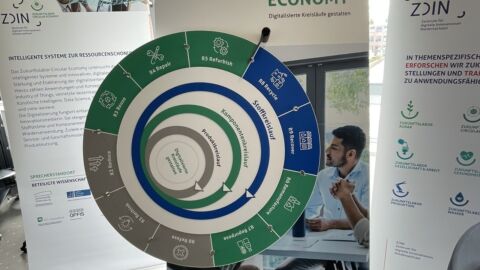
Das Zukunftslabor Circular Economy war vom 31.03. bis 04.04.2025 auf der Hannover Messe vertreten. Am Stand präsentierte das Team das Exponat „Digitized Circular Economy Drehrad“, das die gesellschaftlich und wirtschaftlich relevanten Themen Nachhaltigkeit und Digitalisierung miteinander verknüpft. Messebesucher erhielten ansprechend aufbereitete Informationen rund um diese Themen und wurden dazu eingeladen, an einem interaktiven Austausch mit Wissenschaftlerinnen und Wissenschaftlern teilzunehmen. Durch die Nutzung des Drehrads konnte das Bewusstsein („Awareness“) für die Bedeutung der Circular Economy bei Besucherinnen und Besuchern gesteigert werden. Gleichzeitig konnten Forschende anhand des Exponats das Potential der Circular Economy für Wirtschaft und Gesellschaft anschaulich erläutern und gemeinsam mit Praxispartnern neue Impulse und Herausforderungen identifizieren.
Beteiligte ZDIN-Einrichtungen
- Ostfalia Hochschule für angewandte Wissenschaften
Beitrag
- Art des Beitrags: Exponat
- Datum: 31.03.2025
- Ort: Hannover
Technologiedemonstratoren

Transfer-Workshops
This workshop aims at presenting the results from designing, conducting and evaluating educational measures. It furthermore aims at discussing blended learning vs. face-to-face teaching methods, learning goals and outcomes for interdisciplinary courses. It consists of a presentation part and an interactive discussion part with involvement of the audience.
Workshop
- Datum: 22.10.2025
- Ort: STC 2025, Osnabrück
The design of efficient, eco-friendly, and scalable energy systems is critical to addressing the environmental impacts of current energy practices, with renewable energy offering vast untapped potential. This workshop focuses on leveraging data-driven approaches and FAIR principles to enhance energy system innovation, addressing challenges in data availability, processing, and applications such as supply-demand predictions, predictive maintenance, and privacy-conscious analysis. With a special focus on FAIR data and the challenges and opportunities of research data and software for 2025, we invite experts from academia and industry to discuss their experiences and best practices in this domain.
Workshop
- Datum: 17.06.2025
- Ort: Rotterdam
The rapid advancement of health technologies, including AI and data-driven systems, demands updated competencies for health professionals, especially in nursing. This workshop is part of the update of the International Recommendations Framework of Core Competencies for Nurses. The aim of the workshop is to validate the results of an online survey and to recruit participants for case studies. Participants feedback will inform the revision process, ensuring the framework aligns with the diverse and dynamic requirements of the healthcare sector in the digital age.
Workshop
- Datum: 20.05.2025
- Ort: MIE 2025, Glasgow, UK
Im Workshop wurde ein neuartiges Lösungskonzept zur automatisierten digitalen Überwachung des Stallklimas in der Hühermast durch Kontrollbehörden (Veterinärämtern) mit Stakeholdern (Landwirt*innen, Veterinärämter, Tierschutz, Zertifizierungsstellen) diskutiert. Im Ergebnis wurden verschiedene berechtigte Bedenken bei einer möglichen Einführung der Lösung zusammengetragen und dringenderer Digitalisierungsbedarf an anderen Stellen der Kommunikation zwischen Erzeugern und Veterinärämtern sowie der Veterinärämter untereinander aufgezeigt. Die Ergebnisse werden wissenschaftlich ausgewertet und veröffentlicht.
Workshop
- Datum: 16.05.2025
- Ort: Vechta
Digitale Lösungen für ein intelligentes und zukunftsfähiges Wassermanagement: Daran forscht das Zukunftslabor Wasser des Zentrums für digitale Innovationen Niedersachsen (ZDIN). Gemeinsam mit Partnern aus der Wasserwirtschaft untersuchen die Wissenschaftler*innen die Potenziale der Digitalisierung für einen nachhaltigen Umgang mit Wasser. Zu den Praxispartnern zählen regionale Wasserversorger, Behörden und öffentliche Institutionen, Verbände und Interessenvertretungen sowie Technologieunternehmen aus der Wasserwirtschaft. Am 07. und 08.05.2025 trafen sich die Wissenschaftler*innen des Zukunftslabors mit Vertreter*innen aus der Praxis, um über die Forschung im Zukunftslabor zu diskutieren und die Zusammenarbeit zu vertiefen. Insgesamt nahmen ca. 50 Vertreter*innen aus Wissenschaft und Praxis an diesem Vernetzungstreffen teil, das in den ecos workspaces in Oldenburg stattfand.
Workshop
- Datum: 07.05.2025
- Ort: Oldenburg
Fort- und Weiterbildungen
- Kathrin Toppel (Hochschule Osnabrück)
- Angebotsart: Arbeitsgruppe
- Datum: 19.06.2025
- Prof. Dr. Robby Andersson (Hochschule Osnabrück, Lehrstuhl Tierhaltung und Produkte)
- Angebotsart: Sonstiges
- Datum: 06.05.2025
- M.Sc., Joana Warnecke (Technische Universität Braunschweig, Peter L. Reichertz Institut für Medizinische Informatik)
- Angebotsart: Sonstiges
- Datum: 21.10.2024 - 20.02.2025
- Prof. Dr.-Ing. Axel Hahn (Deutsches Zentrum für Luft- und Raumfahrt (DLR))
- Angebotsart: Sonstiges
- Datum: 15.10.2024 - 15.02.2025
- Prof. Dr. Johanna Apfel-Starke
- Angebotsart: Sonstiges
- Datum: 24.09.2024 - 31.03.2025
Studienabschlussarbeiten
- M. Sc. Moritz Proff (Technische Universität Braunschweig, Institut für Automobilwirtschaft und Industrielle Produktion)
- Art: Bachelor
- Themencluster: Supply Chain Management
- Datum: 02.12.2025 - 02.03.2026
- M. Sc. Max Westermann (Leibniz Universität Hannover, Institut für Montagetechnik und Industrierobotik)
- Art: Bachelor
- Themencluster: Circular Economy
- Datum: 03.11.2025
- M. Sc. Moritz Proff (Technische Universität Braunschweig, Institut für Automobilwirtschaft und Industrielle Produktion)
- Art: Bachelor
- Themencluster: Supply Chain Management
- Datum: 27.10.2025 - 27.02.2026
- M. Sc. Max Westermann (Leibniz Universität Hannover, Institut für Montagetechnik und Industrierobotik)
- Art: Master
- Themencluster: Circular Economy
- Datum: 16.10.2025
- Prof. Dr.-Ing. Jens Heger (Leuphana Universität Lüneburg)
- Art: Bachelor
- Themencluster: Prozessoptimierung
- Datum: 13.10.2025