

ZDIN-Zahlen im Detail
Das umfangreiche ZDIN-Netzwerk aus Wissenschaft und Wirtschaft spannt sich über ganz Niedersachsen. Gemeinsam verzeichnen die Zukunftslabore und die Koordinierungsstelle beeindruckende Projekterfolge, die auf dieser Seite im Detail vorgestellt werden.
Wissenschaftliche Veröffentlichungen
One of the major challenges in pediatric intensive care is the detection of life-threatening health conditions under acute time constraints and performance pressure. This includes the assessment of pe ...
One of the major challenges in pediatric intensive care is the detection of life-threatening health conditions under acute time constraints and performance pressure. This includes the assessment of pediatric organ dysfunction (OD) that demands extraordinary clinical expertise and the clinician's ability to derive a decision based on multiple information and data sources. Clinical decision support systems (CDSS) offer a solution to support medical staff in stressful routine work. Simultaneously, detection of OD by using computerized decision support approaches has been scarcely investigated, especially not in pediatrics.Objectives: The aim of the study is to enhance an existing, interoperable, and rule-based CDSS prototype for tracing the progression of sepsis in critically ill children by augmenting it with the capability to detect SIRS/sepsis-associated hematologic OD, and to determine its diagnostic accuracy.Methods: We reproduced an interoperable CDSS approach previously introduced by our working group: (1) a knowledge model was designed by following the commonKADS methodology, (2) routine care data was semantically standardized and harmonized using openEHR as clinical information standard, (3) rules were formulated and implemented in a business rule management system. Data from a prospective diagnostic study, including 168 patients, was used to estimate the diagnostic accuracy of the rule-based CDSS using the clinicians' diagnoses as reference.Results: We successfully enhanced an existing interoperable CDSS concept with the new task of detecting SIRS/sepsis-associated hematologic OD. We modeled openEHR templates, integrated and standardized routine data, developed a rule-based, interoperable model, and demonstrated its accuracy. The CDSS detected hematologic OD with a sensitivity of 0.821 (95% CI: 0.708-0.904) and a specificity of 0.970 (95% CI: 0.942-0.987).Conclusion: We could confirm our approach for designing an interoperable CDSS as reproducible and transferable to other critical diseases. Our findings are of direct practical relevance, as they present one of the first interoperable CDSS modules that detect pediatric SIRS/sepsis-associated hematologic OD.
Autor*innen
- Louisa Bode (Technische Universität Braunschweig, Peter L. Reichertz Institut für Medizinische Informatik)
- Sven Schamer (Medizinische Hochschule Hannover)
- Julia Böhnke (Medizinische Hochschule Hannover)
- Prof. Dr.-Ing. Oliver J. Bott (Hochschule Hannover, Abteilung Information und Kommunikation)
- Prof. Dr. med. Dr.-Ing. Michael Marschollek (Leibniz Universität Hannover, Forschungszentrum L3S)
- PD Dr. med. Thomas Jack (Medizinische Hochschule Hannover)
- Antje Wulff (Technische Universität Braunschweig, Peter L. Reichertz Institut für Medizinische Informatik)
- ELISE Study Group (Medizinische Hochschule Hannover)
Veröffentlichung
- Im Rahmen des Buches/Journals bzw. Konferenz: Applied Clinical Informatics
- Datum: 26.09.2022
- Link zur Veröffentlichung
Many physically demanding tasks require the help of a second person to avoid the otherwise harmful effects of musculoskeletal disorders when performing the task alone. The workforce in many domains, s ...
Many physically demanding tasks require the help of a second person to avoid the otherwise harmful effects of musculoskeletal disorders when performing the task alone. The workforce in many domains, such as nursing care, is rapidly declining. Furthermore, complex repositioning tasks during patient care make it all the more difficult to find a simple solution. Therefore, robotic assistance could be a perfect fit to support this scenario. For this purpose, we conducted a study where 12 caregivers were given the task of repositioning a patient simulator (80 kg) within a nursing bed with the help of a robotic assistant. We measured the physical relief potential using muscle activity and force data while examining this human-robot collaboration problem with two different control approaches, namely a virtual reality-based and a rule-based robot control method. The results show that both methods effectively supported the chosen task with varied strengths and weaknesses. The main advantage of VR-based control is the ability to adapt to the situation and execute quickly (6.61 s), but this also results in higher acting robot forces (35.70 N). With the rule-based control variant, a lower speed of support can be noted on average (10.84 s), but better robot interaction forces (14.95 N) can be discovered in return.
Autor*innen
- Christian Kowalski (Carl von Ossietzky Universität Oldenburg)
- Anna Brinkmann (Carl von Ossietzky Universität Oldenburg)
- Dr.-Ing. Sandra Hellmers (Carl von Ossietzky Universität Oldenburg)
- Conrad Fifelski-von Böhlen (Carl von Ossietzky Universität Oldenburg)
- Prof. Dr.-Ing. Andreas Hein (Carl von Ossietzky Universität Oldenburg, Abteilung Assistenzsysteme und Medizintechnik, OFFIS Institut für Informatik, FuE-Bereich Gesundheit)
Veröffentlichung
- Im Rahmen des Buches/Journals bzw. Konferenz: 2022 31st IEEE International Conference on Robot and Human Interactive Communication (RO-MAN)
- Datum: 29.08.2022 - 02.09.2022
- Link zur Veröffentlichung
This paper presents the concept and current workin progress of an android robot-patient for communication training of relatives of critically ill non-verbal patients with motor impairment. Additionall ...
This paper presents the concept and current workin progress of an android robot-patient for communication training of relatives of critically ill non-verbal patients with motor impairment. Additionally, this paper presents the initial results of a field study regarding the social interactions of a patient in need of out-of-hospital intensive care. Furthermore, the implementation of the ongoing development, different levels of abstractions of the android robot-patient and the subsequent training scenario are described. Subsequently, an initial simulation of an interaction mode is implemented, presented and compared to the actual patient’s behavior.
Autor*innen
- Jan Hendrik Röhl (Carl von Ossietzky Universität Oldenburg)
- Dr.-Ing. Sandra Hellmers (Carl von Ossietzky Universität Oldenburg)
- Dr. oec. troph. Rebecca Diekmann (Carl von Ossietzky Universität Oldenburg)
- Prof. Dr.-Ing. Andreas Hein (Carl von Ossietzky Universität Oldenburg, Abteilung Assistenzsysteme und Medizintechnik, OFFIS Institut für Informatik, FuE-Bereich Gesundheit)
Veröffentlichung
- Im Rahmen des Buches/Journals bzw. Konferenz: 2022 9th IEEE RAS/EMBS International Conference for Biomedical Robotics and Biomechatronics (BioRob)
- Datum: 21.08.2022 - 24.08.2022
- Link zur Veröffentlichung
Digitization in the healthcare sector is an ongoing process in which it is necessary for success to turn those affected into participants. Many considerations are limited to addressing only physicians ...
Digitization in the healthcare sector is an ongoing process in which it is necessary for success to turn those affected into participants. Many considerations are limited to addressing only physicians and nurses in the digitization of healthcare, neglecting the fact that the role of the computer scientist for the necessary digital infrastructures of care plays an equally important role. A common understanding and a common language is essential so that the designated roles can shape the digital transformation together in a meaningful way. The development of competencies in the field of medical informatics is a key prerequisite here. HiGHmeducation as part of the project HiGHmed of the Medical Informatics Initiative (MII) focuses on the nationwide development of eLearning courses to make the required medical informatics competencies for the digital transformation in healthcare accessible for various target groups. In this article, one of these courses is presented and evaluation results of 3 years of implementation are presented. The course of the Department of Medical Informatics Göttingen addresses the topic of clinical decision support systems.
Autor*innen
- Stefan Rühlicke (Georg-August-Universität Göttingen, Universitätsmedizin Göttingen, Institut für Medizinische Informatik)
- Carolin Klembt (Universitätsmedizin Göttingen)
- Prof. Dr. Dagmar Krefting (Universitätsmedizin Göttingen, Institut für Medizinische Informatik)
Veröffentlichung
- Im Rahmen des Buches/Journals bzw. Konferenz: 2022 IEEE German Education Conference (GeCon)
- Datum: 11.08.2022 - 12.08.2022
- Link zur Veröffentlichung
Abstract: Digitalization offers many new opportunities to make learning and teaching more attractive, flexible, interesting and also more effective. However, the transition from traditional classroom ...
Abstract: Digitalization offers many new opportunities to make learning and teaching more attractive, flexible, interesting and also more effective. However, the transition from traditional classroom teaching to digital teaching is also challenging. This chapter deals with concepts and techniques of digital teaching in academic and continuing education. It is intended as a practical guide to successfully delivering online courses. Its main part focuses on presenting a five-phase didactical framework starting from welcoming of the learners to summative assessment and course completion. The didactically motivated framework is linked with suitable tools of learning management systems (LMSs) to support the activities of the phases. Two real life course examples from medical informatics education illustrate how online courses can be set up based on the presented framework using the open-source LMSs Moodle and ILIAS. The chapter also addresses necessary skills for educators and learners for successful digital learning and discusses the specifics of digital teaching in continuing education.
Autor*innen
- Prof. Dr.-Ing. Oliver J. Bott (Hochschule Hannover, Abteilung Information und Kommunikation)
- Dr. Marianna Behrends (Technische Universität Braunschweig, Peter L. Reichertz Institut für Medizinische Informatik)
- Benning Nils-Hendrik (Universität Heidelberg)
- Ina Hoffmann (Technische Universität Braunschweig, Peter L. Reichertz Institut für Medizinische Informatik)
- Marie-Louise Witte (Hochschule Hannover, Abteilung Information und Kommunikation)
Veröffentlichung
- Im Rahmen des Buches/Journals bzw. Konferenz: Nursing Informatics
- Datum: 26.07.2022
- Link zur Veröffentlichung
Wissenschaftliche Vorträge
Referent*innen
- Bianca Frenzel (Hochschule Hannover)
- Prof. Dr.-Ing. Oliver J. Bott (Hochschule Hannover, Abteilung Information und Kommunikation)
- Matthias Katzensteiner (Hochschule Hannover)
- Nina Schewe
- Prof. Dr. Stephan Immenschuh (Medizinische Hochschule Hannover)
- apl. Prof. Dr. Cornelia Blume (Leibniz Universität Hannover)
Vortrag
- Im Rahmen der Veranstaltung: 16. DVMD-Fachtagung - 50 Jahre DVMD: Informationsmanagement im Wandel
- Datum: 12.05.2022
Referent*innen
- Fatih Avci (Hochschule Hannover)
- Maximilian Zubke (Technische Universität Braunschweig, Peter L. Reichertz Institut für Medizinische Informatik)
- Bianca Frenzel (Hochschule Hannover)
- Prof. Dr. Stephan Immenschuh (Medizinische Hochschule Hannover)
- Matthias Katzensteiner (Hochschule Hannover)
- Prof. Dr.-Ing. Oliver J. Bott (Hochschule Hannover, Abteilung Information und Kommunikation)
- Nina Schewe
Vortrag
- Im Rahmen der Veranstaltung: 16. DVMD-Fachtagung - 50 Jahre DVMD: Informationsmanagement im Wandel
- Datum: 12.05.2022
Außerwissenschaftliche Beiträge
Referent*innen
- Jens Hüsers (Hochschule Osnabrück)
Beitrag
- Anlass: Tagung: Digitale Kompetenztransformation im Gesundheitswesen
- Datum: 14.12.2022
Referent*innen
- Matthias Katzensteiner (Hochschule Hannover)
Beitrag
- Anlass: Kultur trifft Gesundheit
- Datum: 07.07.2022 - 07.07.2022
Referent*innen
- Prof. Dr.-Ing. Oliver J. Bott (Hochschule Hannover, Abteilung Information und Kommunikation)
Beitrag
- Anlass: ZDIN Podcast "Wissen schafft Innovation"
- Datum: 10.06.2022 - 10.06.2022
Referent*innen
- Prof. Dr.-Ing. Oliver J. Bott (Hochschule Hannover, Abteilung Information und Kommunikation)
Beitrag
- Anlass: "Digitaltalk Niedersachsen" im Rahmen der ROSE Abschlussveranstaltung
- Datum: 01.06.2022 - 01.06.2022
Referent*innen
- Prof. Dr.-Ing. Oliver J. Bott (Hochschule Hannover, Abteilung Information und Kommunikation)
Beitrag
- Anlass: Vortrag auf der 16. DVMD-Fachtagung - 50 Jahre DVMD: Informationsmanagement im Wandel
- Datum: 12.05.2022
Messebeiträge
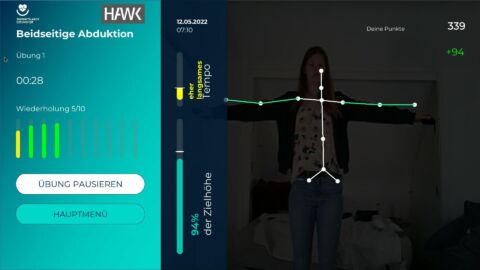
Das Zukunftslabor Gesundheit hat beim Digitalgipfel 2022 in Hannover teilgenommen. Die Veranstaltung stand unter dem Titel "Bessere Medizin durch Künstliche Intelligenz (KI)". Im Rahmen der Veranstaltung hat das ZLG mit den Demonstratoren "Physiotherapie-App", sowie den beiden Online-Kursen "Das lernende Gesundheitswesen - So lernt es" und "Patientennahe Sensorsysteme in der Pflege". Die Anwesenden konnten sich am Stand des ZLG die Kurse anschauen und die Physiotherapie-App ausprobieren.
Beteiligte ZDIN-Einrichtungen
- HAWK Hochschule für angewandte Wissenschaft und Kunst Hildesheim/Holzminden/Göttingen
- Hochschule Hannover
- Universitätsmedizin Göttingen
Beitrag
- Art des Beitrags: Demonstratoren
- Datum: 30.11.2022
- Ort: Hannover
Im Rahmen der Techtide 2022 haben die Zukunftslabore Energie, Gesundheit und Produktion an einer Podiumsdiskussion teilgenommen. Diskutiert wurde über das Thema "Digitale Transparenz stärken - mit KI", mit Einblicken aus den Schwerpunkten der vertretenden Zukunftslabore.
Beteiligte ZDIN-Einrichtungen
- Carl von Ossietzky Universität Oldenburg
Beitrag
- Art des Beitrags: Podiumsdiskussion
- Datum: 13.09.2022
- Ort: Hannover
Im Rahmen der diesjährigen Ideenexpo war der ZLG Verbundpartner HAWK mit dem neu entwickelten Technologiedemonstrator, einer App zur Unterstützung von Physiotherapie vertreten. Die Besucherinnen und Besucher konnten die App vor Ort ausprobieren
Beteiligte ZDIN-Einrichtungen
- HAWK Hochschule für angewandte Wissenschaft und Kunst Hildesheim/Holzminden/Göttingen
Beitrag
- Art des Beitrags: Exponat
- Datum: 02.07.2022
- Ort: Hannover
Technologiedemonstratoren



Transfer-Workshops
Gemeinsam mit den Partnern des Netzwerk Versorgungskontinuität Osnabrück und dem Gesundheitscampus hat die Hochschule eine Tagung veranstaltet, in der u.a. die Ergebnisse des ZLG TP3 (Demonstrator 2) vorgestellt und diskutiert wurden. Dabei ging es insbesondere um die Nutzung von Fortbildungsangeboten in der Gesundheitsversorgung, bei dem der Demonstrator 2 (Curriculum und Kurs Data Analytics Health Care) eingesetzt werden kann.
Workshop
- Datum: 14.12.2022
- Ort: Osnabrück
Als Ergebnis des Treffens wurden mehrere Themen identifiziert, für die der weitere Austausch zwischen dem Zukunftslabor Gesundheit und seinem assoziierten Partner Magrathea sinnvoll erscheint. Magrathea kann sich vorstellen, in allen drei Teilprojekten kooperativ tätig zu sein und formulierte bereits mehrere Ideen. Eine Priorisierung und Konkretisierung der weiteren Arbeiten ist für Q1/2023 geplant.
Workshop
- Datum: 27.09.2022
- Ort: Onlinemeeting
Der Workshop fand im Rahmen der Abschlussveranstaltung des ROSE Projektes statt. Das ROSE Projekt befasst sich mit dem lernenden Gesundheitswesen in der Region Osnabrück/Emsland. Mithilfe verschiedener Kreativtechniken wurden aus dem Projekt gewonnene Lehren genutzt um Vorschläge zu entwickeln, wie eine lernende Organisation aussehen kann.
Workshop
- Datum: 01.06.2022
- Ort: Osnabrück
Fort- und Weiterbildungen
Studienabschlussarbeiten
- Prof. Dr.-Ing. Andreas Hein (Carl von Ossietzky Universität Oldenburg, Abteilung Assistenzsysteme und Medizintechnik, OFFIS Institut für Informatik, FuE-Bereich Gesundheit)
- Art: Bachelor
- Themencluster: Datenmanagement und -analyse
- Datum: 15.12.2022 - 04.05.2023
- Prof. Dr.-Ing. Andreas Hein (Carl von Ossietzky Universität Oldenburg, Abteilung Assistenzsysteme und Medizintechnik, OFFIS Institut für Informatik, FuE-Bereich Gesundheit)
- Art: Bachelor
- Themencluster: Künstliche Intelligenz
- Datum: 02.12.2022 - 12.04.2023
- Prof. Dr. Frauke Koppelin (Jade Hochschule - Wilhelmshaven Oldenburg Elsfleth)
- Art: Dissertation
- Themencluster: Modellierung und Simulation
- Datum: 01.11.2022
- Prof. Dr.-Ing. Andreas Hein (Carl von Ossietzky Universität Oldenburg, Abteilung Assistenzsysteme und Medizintechnik, OFFIS Institut für Informatik, FuE-Bereich Gesundheit)
- Art: Bachelor
- Themencluster: Datenmanagement und -analyse
- Datum: 21.10.2022 - 14.03.2023
- Prof. Dr. Frauke Koppelin (Jade Hochschule - Wilhelmshaven Oldenburg Elsfleth)
- Art: Master
- Themencluster: Vorgehensmodelle und Entwicklungsmethoden
- Datum: 01.09.2022